Introduction
link building mistakes to avoid : Link building is one of the most powerful SEO strategies to boost your website’s ranking and authority, visibility, and organic traffic. But here’s the truth — even experienced marketers still make link building mistakes that silently kill their rankings.
In 2025, Google’s algorithms are smarter than ever. It’s not just about how many backlinks you have — it’s about how natural, relevant, and diverse your link profile looks.
If you’re making any of the following link building mistakes, your SEO strategy might be doing more harm than good.
In this guide, we’ll break down the top 8 link building mistakes to avoid, why they’re risky, and what to do instead — so you can build a strong, trustworthy backlink profile that drives real results.
1. Focusing Only on Dofollow Links
Many SEO beginners believe that only dofollow links matter because they pass link equity (“link juice”) to your website. While that’s partially true, ignoring nofollow links is a major mistake.
Why It’s a Mistake
According to Google’s guidelines, a natural backlink profile will have a mix of dofollow and nofollow links. A dofollow backlink sends authority from the source URL to the linked site while a nofollow backlink does not. If the nofollow backlinks present in your profile are mostly or only from reputable sources, then it can quite benefit you.
SEMrush (2018b) mentioned that having a high percentage of nofollow links might, in turn, cause an overall decrease in the number of visited pages on a website
- Building brand visibility and trust
- Diversifying your backlink profile
What to Do Instead
- Target relevant sites regardless of link type.
- Earn links from social media, forums, and press mentions that may use nofollow tags.
- Maintain a 70:30 ratio between dofollow and nofollow links for a healthy link profile.
Pro Tip: Some nofollow links can still pass signals indirectly. When users click through and engage with your content, Google notices!
2. Relying Too Much on DR/DA Metrics
It’s common to chase backlinks from websites with a high Domain Rating (DR) or Domain Authority (DA) — but relying solely on these numbers is misleading.
Why It’s Risky
Metrics like DA and DR are third-party indicators, not official Google ranking factors. Some websites have high DR/DA but very low traffic, poor engagement, or spammy backlink profiles. Getting links from such sites won’t improve your SEO much — and can even damage your reputation.
What to Do Instead
- Evaluate websites based on real organic traffic, content relevance, and user engagement.
- Use tools like Ahrefs, SEMrush, or Ubersuggest to assess a site’s organic traffic trends.
- Focus on quality over quantity — one link from a relevant, trustworthy blog is better than ten from low-quality sites.
Pro Tip: Before building a link, check if the site ranks for keywords in your niche. If it doesn’t, its authority might be inflated.
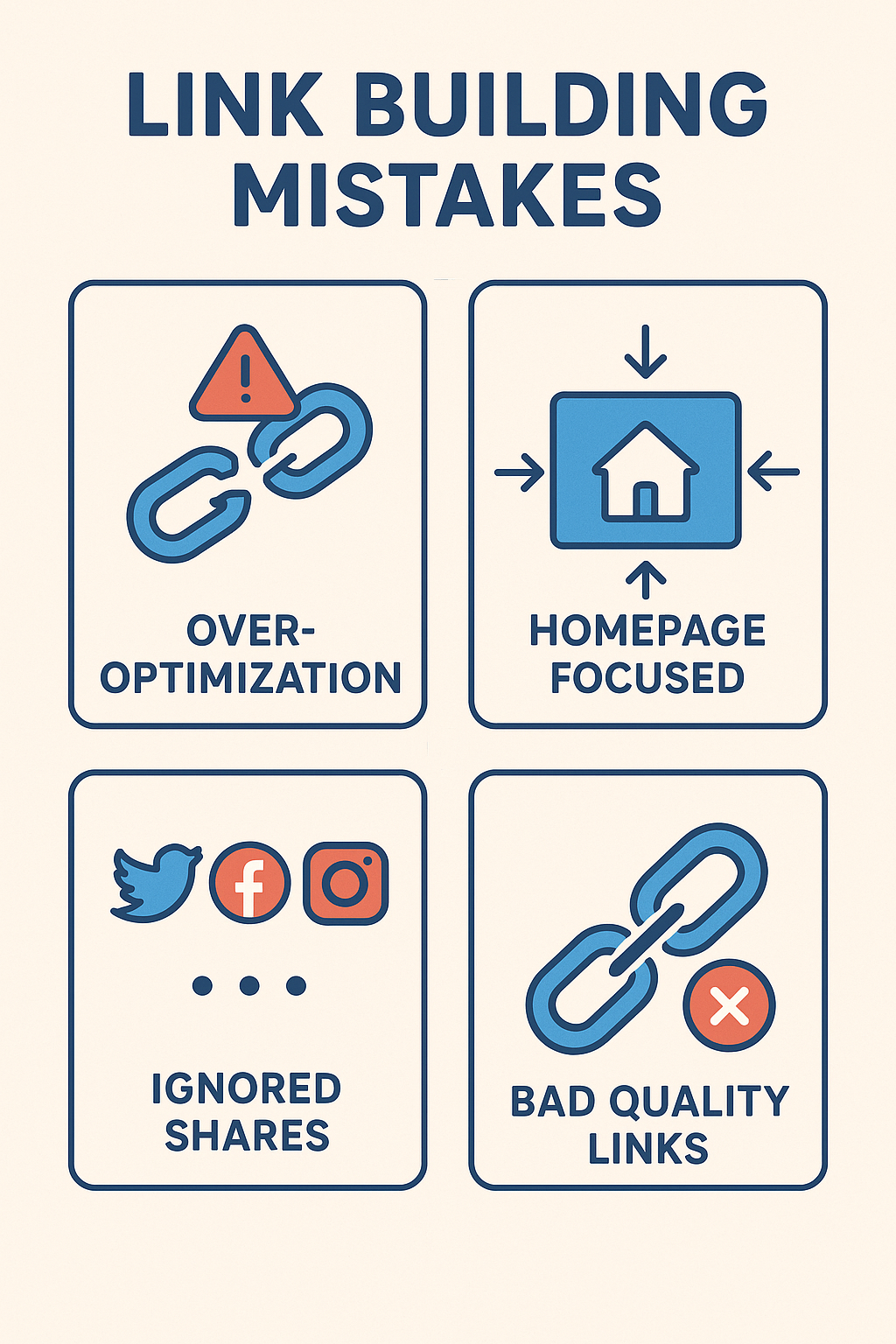
3. Over-Optimizing Anchor Text
Anchor text means it is text that is clickable in a hyperlink, it means we have to tells search engines what your linked page is about. Main important point is don’t link to text in keywords it will be hurt your seo in your website.
Why It’s a Mistake
A situation will arise where each time a link is obtained and the linking page uses one and the same keyword (e.g. the anchor text is “best SEO services”) because of this Google might interpret this as spamor a manipulativeification.
What to Do Instead
Diversify your anchor texts. Use a mix of:
- Branded anchors (e.g., Ravi Digital Services)
- Generic anchors (e.g., learn more, this guide)
- Partial match anchors (e.g., SEO services in Hyderabad)
- Long-tail anchors (e.g., tips to improve your SEO link building strategy)
Pro Tip: Keep exact-match keyword anchors under 10% of your total backlinks for a natural profile.
4. Relying on Only One Link Building Tactic
If your entire link building strategy depends on one single method — like guest posting, blog commenting, or directory submissions — you’re setting yourself up for risk.
Why It’s Risky
Google’s algorithm updates frequently. A method that works today may lose value tomorrow. When that happens, your rankings could drop overnight if your entire strategy depends on it.
What to Do Instead
- Use a diversified strategy:
- Guest blogging
- Broken link building
- Digital PR campaigns
- HARO (Help A Reporter Out) responses
- Resource page outreach
- Local citations
- Guest blogging
- Experiment with content-driven link building — create valuable resources like case studies, infographics, or tools that naturally attract backlinks.
Pro Tip: Track which tactics bring you the most results and adjust your efforts every quarter.
5. Ignoring Unlinked Brand Mentions
When other websites mention your brand name but don’t link back to you, that’s a missed opportunity.
Why It Matters
These mentions already show trust or awareness. Converting them into backlinks is one of the easiest and most natural link building tactics.
What to Do Instead
- Use tools like Google Alerts, Mention, or SEMrush Brand Monitoring to find unlinked mentions.
- Reach out to the website owner or editor politely:
“Thanks for mentioning our brand! Would you mind adding a link for your readers’ convenience?”
Pro Tip: When you get backlinks from mentions, they look natural and editorially earned — exactly what Google loves.
6. Focusing Only on the Homepage
It’s tempting to build all your backlinks to your homepage, but that’s another major SEO mistake.
Why It’s a Problem
A strong site has link equity distributed across multiple pages — blogs, service pages, and product pages. When all your backlinks go to the homepage, it creates an unnatural pattern.
What to Do Instead
- Build links to inner pages that add value to users.
- Promote your blog content, guides, or case studies for deep link building.
- Interlink those pages internally to pass link equity to your homepage.
Pro Tip: Use a “content cluster” model — create a main topic page supported by related articles, and earn backlinks to each.
7. Ignoring Local Backlinks
If you want to target your business in specific location , you have mto focus on the first on the local backlinks. After that you can do your business type backlinks
Why It Matters
It will tell that your business is relevant to a particular location , this will help to increase local seo rankings of your site different places like google maps and local search results etc..
What to Do Instead
- Get listed in local directories and business listings (Google Business Profile, Justdial, Yelp, etc.).
- Partner with local influencers, NGOs, or event organizers for collaborations and backlinks.
- Sponsor local events, college festivals, or community blogs for citations.
Pro Tip: Combine local backlinks with location-based keywords like “digital marketing agency in Hyderabad” for maximum impact.
8. Ignoring Social Media in Link Building
Many marketers underestimate the power of social media in link building. While social shares don’t directly affect rankings, they indirectly boost your SEO.
Why It’s a Mistake
Social signals (likes, shares, mentions) can amplify your content’s reach. More visibility means more chances of other sites discovering and linking to your content organically.
What to Do Instead
- Share your content regularly on platforms like LinkedIn, X (Twitter), Facebook, and Pinterest.
- Join relevant groups and communities to share value-driven content.
- Encourage readers and influencers to share your posts.
Pro Tip: Every share increases your content’s exposure — and that’s how organic backlinks start multiplying.
Bonus Tip: Track Your Link Profile Regularly
Even if you follow all the right strategies, it’s very difficult l to monitor your backlinks regularly. Toxic or spammy links can sneak in and hurt your SEO ranking on your website.
📖 Also Read
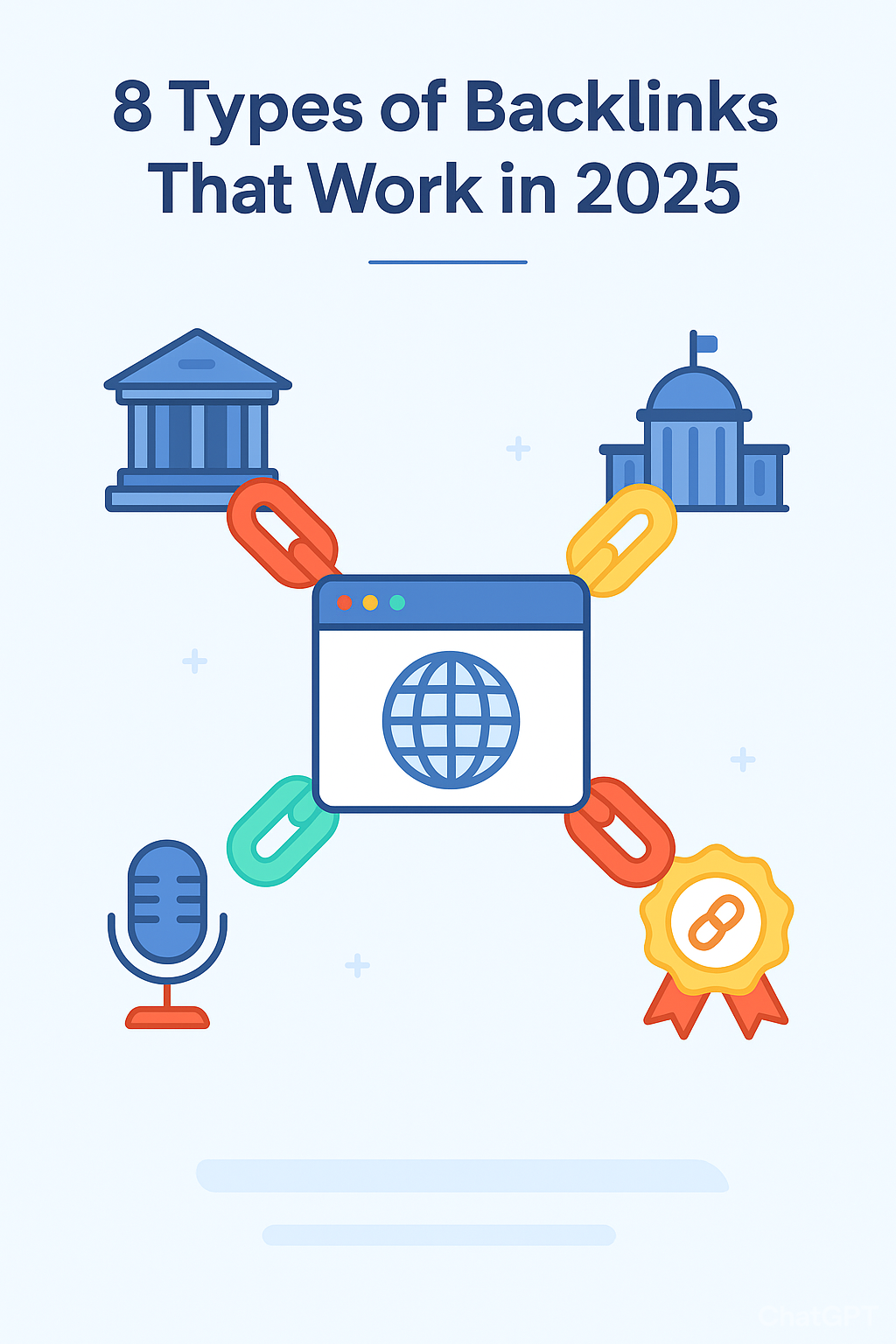
8 Types of Backlinks That Work in 2025Use These Tools:
- Google Search Console – for tracking new and lost backlinks.
- Ahrefs / SEMrush – for detailed backlink analysis and disavow lists.
- Moz Link Explorer – for domain authority tracking and anchor text insights.
Pro Tip: Review your backlinks monthly and disavow any spammy links to maintain a clean, healthy profile.
Final Thoughts
There is none of the past about shortcuts or pure numbers and link building is all about real, useful relationships made on the web. The main focus of top link builders is still the quality of the link, so, relevance and trust are not out of the question at all. It will make a person avoid these 8 link building mistakes, and, to a large extent, this will have a very good effect on the authority of your site, besides, the ranking. Not only would this increase your website traffic, but it would also erase any doubt of the fact that the link building goals of the search engines were not only met but surpassed by building a digital reputation that is bulletproof.
Frequently Asked Questions (FAQs)
1. Why is link building important for SEO?
Link building helps search engines understand your website’s authority and relevance. The more quality backlinks you earn, the higher your chances of ranking on Google.
2. Are nofollow links worth it?
Yes, nofollow links still bring traffic, brand trust, and diversification to your backlink profile. They’re a key part of a natural SEO strategy.
3. How can I find unlinked brand mentions?
You can use tools like Google Alerts or SEMrush Brand Monitoring to track where your brand is mentioned online without a link.
4. How many backlinks do I need to rank?
There’s no fixed number. Quality matters more than quantity. Focus on earning relevant backlinks from authoritative, high-traffic websites.
5. What’s the safest way to build backlinks in 2025?
The safest approach is white-hat link building: create valuable content, build genuine relationships, and focus on long-term authority instead of shortcuts.