Introduction
The financial world is in upheaval because of cryptocurrencies. The more Bitcoin and Ether operate amongst individuals, the more investors there are, more trading is taking place, and more digital transactions take place. On the rise comes greater responsibility for paying taxes. Many a crypto investor is oblivious thus losing fines, penalties, or worse-off with legal issues.At the very least, every person buying, selling, or trading digital assets must understand crypto taxation in India. This guide clears the scene in an honest-to-goodness, literal, and practical insight, thus keeping you compliant and making an intelligent investment
What is Cryptocurrency?
Now, before setting off into taxation, one must understand what cryptocurrency is. Cryptocurrency is just another term for money in digital or virtual form that uses cryptography for its security. In contrast with the traditional currency issued by governments, crypto runs on decentralized networks using blockchain technology.
People use cryptocurrencies for:
- Investment: refers to the purchase and holding of securities or digital assets with the expectation of profit.
- Trading: consists of exchanging one cryptocurrency for another.
- Payments: Some vendors accept cryptocurrency as payment for goods and services..
- Mining or Staking: Making money while validating transactions or holding particular coins
Though in some cases, crypto might be wallets of unimagined gain, most governments worldwide, India being one of them, consider profits made on crypto as taxable income, hence the need to understand how it is taxed.
Why is Crypto Taxation Important?
Some reasons taxation would prove important:
- Legal Compliance:Goster some penalties or confront legal issues if you fail to report crypto gains accurately.
- Transparency: we have to Maintains clean financial records if for personal or business purposes. Because it should be useful for some situations
- Investment Planning: before investing you should Knowing the tax rules allows you to plan when buying, selling, or trading.
Risky neglecting crypto taxes. The rules are stringent in India, and disclaimers about them can lead to an audit or a fine.
Taxable Events in Cryptocurrency
A taxable event occurs when an action triggers a tax liability. In crypto, these include:
Selling Cryptocurrency for Cash
When you sell crypto for fiat money like INR, you earn capital gains. These gains are taxable under Indian law.
Example:
You bought 1 Bitcoin for ₹20 lakh and sold it for ₹25 lakh. Your profit is ₹5 lakh, which is taxable.
Trading One Crypto for Another
Even if you don’t convert crypto to cash, trading one coin for another is taxable. The government treats it as a sale of the first coin and a purchase of the second.
Example:
Exchanging Ethereum for Bitcoin triggers capital gains tax on the Ethereum you spent.
Using Cryptocurrency to Buy Goods or Services
Paying with crypto is also considered a taxable event. The government views it as selling your crypto at the fair market value on the transaction date.
Earning Cryptocurrency
Crypto earned through mining, staking, or airdrops is treated as income and taxed accordingly.Example:
Mining rewards you receive are added to your taxable income and taxed based on your income slab.
How Much Tax Do You Pay on Crypto?
In India, the government introduced clear rules for crypto taxation in 2022. Here’s what you need to know:
Tax Rate
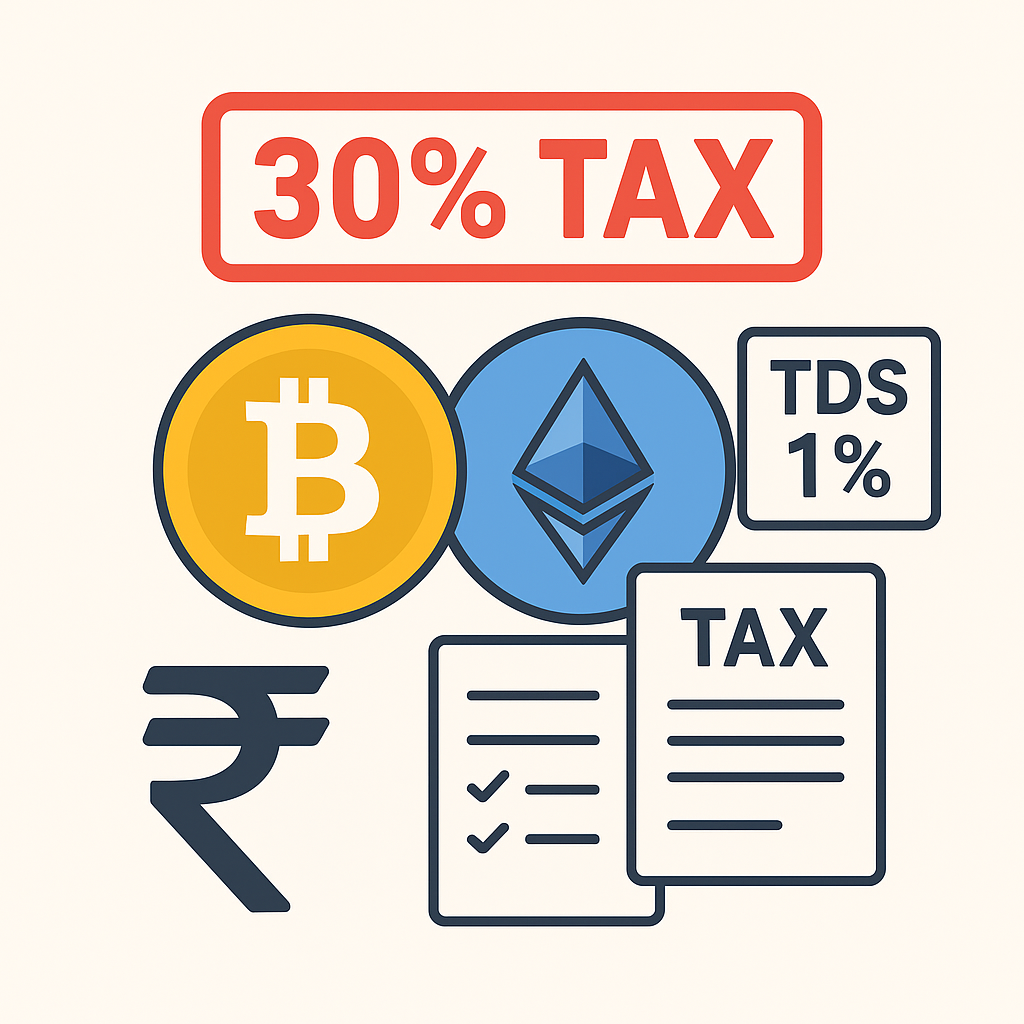
- All gains from crypto are taxed at 30%.
- No deductions are allowed except for the cost of acquisition.
- Losses from crypto cannot be set off against other income.
TDS on Crypto Transactions
- A 1% TDS (Tax Deducted at Source) is applied on payments made for crypto above a certain threshold.
- TDS helps the government track crypto transactions and ensures tax compliance.
Income from Mining or Staking
- Income from crypto mining is considered business income.
- Tax is applicable as per your income slab and may include additional business deductions if applicable.
Example:
If you earn ₹3 lakh from mining in a financial year, this will be added to your total income and taxed according to your tax bracket
How to Report Crypto in Income Tax Returns
Reporting crypto correctly is vital to avoid legal issues. Follow these steps:

Keep Records of All Transactions
- Buy, sell, and trade dates
- Amounts invested and received
- Transaction receipts and invoices
Calculate Capital Gains
- Subtract the cost of acquisition from the sale price.
- Apply 30% tax on the net gains.
File Income Tax Return
- Include crypto gains under “Income from Other Sources” or “Business Income” as applicable.
- Report TDS deducted in your returns to avoid double taxation.
Use Crypto Tax Software
- Software like CoinTracker, Koinly, or CryptoTax can simplify tracking and calculation.
- Helps in generating reports for income tax filing.
Common Challenges in Crypto Taxation
Even for seasoned investors, problems crop up:
- Price Volatility: Sudden price changes in the two cryptos make precise valuation difficult.
- Multiple Exchanges: Dealing on differing platforms can make matters about record-keeping next to impossible.
- Unclear Regulations: Certain aspects of crypto taxation continue to be an area with no much clarity.
- International Transactions:Sending or receiving crypto from a foreign country adds extra layers of intricacy with respect to foreign exchange and tax rules.
Tax-Saving Tips for Crypto Investors
While crypto taxation rules are too strict, there are choices to be made for smart planning:
- Hold Long-Term: Try not to trade all the time. Long-term planning shall offer less complexity
- Maintain Records: Maintain detailed records of purchases, sales, and transfers in spreadsheets.
- Use Tax-Friendly Exchanges: Some exchanges provide tax reports at year-end.
- Consult Experts: A tax advisor’s services can be used to help you find ways of optimizing your crypto taxation legally.
Global Perspective
Crypto taxation varies worldwide:
- USA: Short-term gains taxed as regular income; long-term gains taxed at lower rates.
- UK: Crypto gains bear Capital Gains Tax; some allowances are applicable.
- Japan: it should be Consider profits from cryptocurrency as “miscellaneous income.
- India: in india crypto Gains are taxed at 30%, with 1% TDS, and no deductions are allowed.
Understanding world trends applies to Indian investors, especially those trading on international exchanges.
Frequently Asked Questions (FAQs)
Q1. Do I have to pay tax if I hold crypto without selling?
A: No, tax is only applicable when a taxable event occurs, such as selling or trading crypto.
Q2. Is crypto mining taxable in India?
A: Yes, income from mining is considered business income and taxed according to your income slab.
Q3. Can I offset crypto losses against other income?
A: No, losses from crypto cannot be offset against other income sources.
Q4. How is crypto gifted to someone taxed?
A: Receiving crypto as a gift may be taxable under gift tax rules if it exceeds certain thresholds.
Practical Advice for Crypto Investors
- Stay Updated: Tax rules may change; follow official announcements.
- Track All Transactions: Use spreadsheets or apps to record every trade.
- Declare All Income: Transparency avoids penalties.
- Seek Professional Help: For high-volume traders or miners, consulting a tax expert is recommended.
Conclusion
Cryptocurrencies are an attractive investment proposition but do tax compliances are a must. Understanding crypto taxation in India, knowing what events are taxable, proper reporting, and maintaining adequate records can save one from huge fines and court litigation.
If you were smart about investing, you would also be smart about compliance. By complying with the regulations, you would be able to reap the advantages offered by cryptocurrencies without ever being on the wrong side of the law.